Mohamed Saadaoui
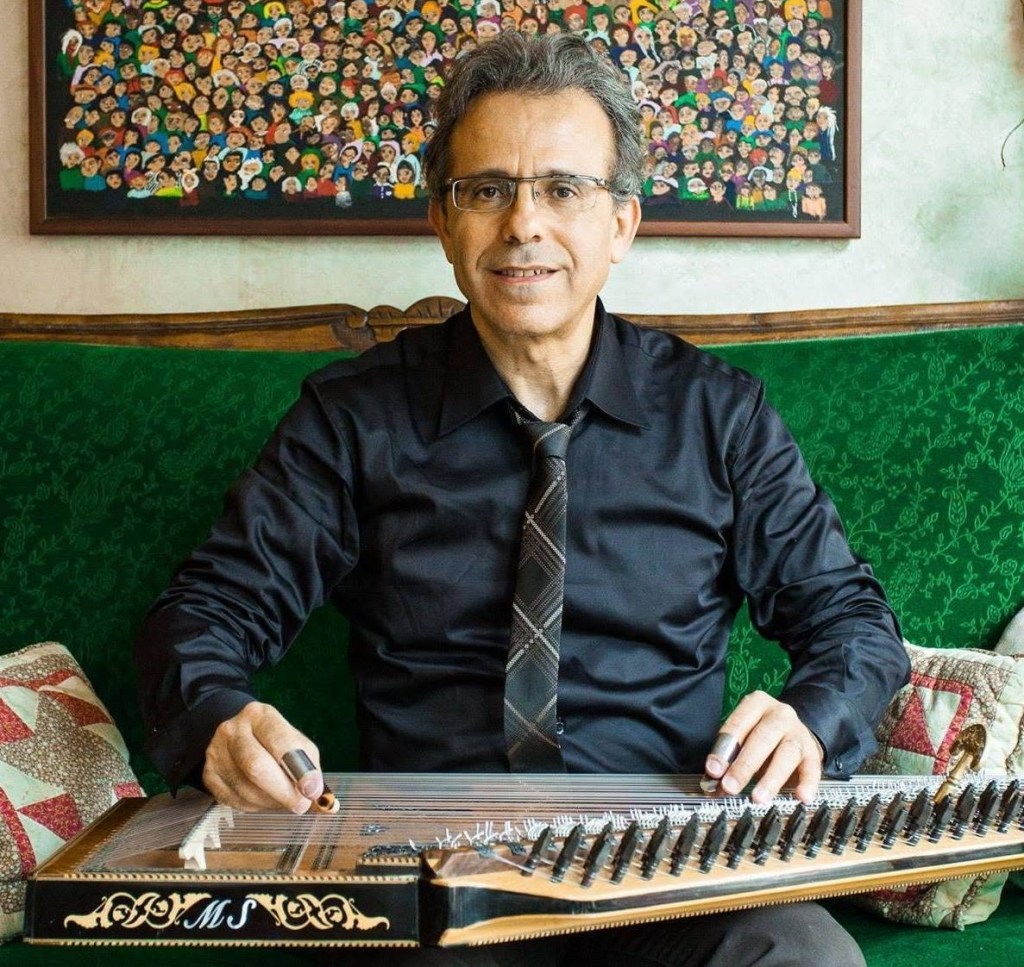
Born in Algiers, a paediatrician by profession and a musician by passion, Mohamed Saadaoui studied music with several teachers: Said Bestandji (music theory and Arab-Andalusian singing), Morsy Salaheddine (piano, music theory and Arabic singing), Noureddine Saoudi (Andalusian nouba), and finally Halil Karaduman (Qanun and Turkish maqams). He in turn taught Andalusian singing, music theory and the Qanun, to children and teenagers among others.
Né à Alger, pédiatre de profession et musicien par passion, Mohamed Saadaoui a étudié la musique avec plusieurs professeurs : Said Bestandji (solfège et chant arabo-andalou), Morsy Salaheddine (piano, solfège et chant arabe), Noureddine Saoudi (nouba andalouse), enfin Halil Karaduman (Qanun et maqams turcs). Il a enseigné à son tour le chant andalou, le solfège et le Qanun, notamment à des enfants et adolescents.
His adventure with the Qanun began in 2003, during a journey to Turkey where he was captivated by the exceptional richness of Ottoman music and culture. In 2007, he met Halil Karaduman, a great master of the instrument and of Turkish music, with whom he worked for five years. From him he took a style and a sound, the rest-stroke, which he later found a way to write down through colored slurs.
Son aventure avec le Qanun commence en 2003, lors d’un voyage en Turquie où il est fasciné par la richesse exceptionnelle de la musique et de la culture ottomanes. En 2007, il rencontre Halil Karaduman, grand maître de l’instrument et de la musique turque, auprès de qui il travaille pendant cinq ans. Il lui doit un style et une sonorité, la butée, qu’il a ensuite trouvé le moyen d’écrire grâce aux liaisons colorées.
In 2010, he founded the Ibnou Sina ensemble, devoted to a fusion of Algerian and Turkish classical music, which gave concerts in Algeria and Turkey alongside the Turkish ensemble directed by Halil Karaduman. He took part in three international Qanun festivals in Turkey (2012, 2015 and 2024), and in December 2015 and 2016 organised two international Qanun symposiums in Algiers, alongside the International Festival of Ancient and Andalusian Music. Young Qanun players from Algeria, Morocco, Tunisia and Syria were able to work there with masters from Turkey, Greece, Iraq and Azerbaijan.
En 2010, il fonde l’ensemble Ibnou Sina, consacré à une fusion entre musique classique algérienne et musique classique turque, qui donne plusieurs concerts en Algérie et en Turquie aux côtés de l’ensemble turc dirigé par Halil Karaduman. Il participe à trois festivals internationaux du Qanun en Turquie (2012, 2015 et 2024) et organise, en décembre 2015 et 2016, deux symposiums internationaux du Qanun à Alger, en marge du Festival international des musiques anciennes et de musique andalouse. De jeunes qanunis d’Algérie, du Maroc, de Tunisie et de Syrie ont pu y travailler avec des maîtres venus de Turquie, de Grèce, d’Irak et d’Azerbaïdjan.
Years of Hanon at the piano taught him the value of systematic work; the Qanun demanded something else, faithful to the spirit of the instrument. Qanun Seen Otherwise is the result: a method in which the eye sees what the hands must do.
Des années de Hanon au piano lui ont appris la valeur du travail systématique ; le Qanun exigeait autre chose, fidèle à l’esprit de l’instrument. Qanun Seen Otherwise en est le fruit : une méthode où l’œil voit ce que les mains doivent faire.
As a paediatrician, he knows that a child walks only after learning to sit, then to stand. The method follows the same path: one string, then two, then three; each gesture acquired before the next. Everything in its own time.
Pédiatre, il sait qu’un enfant ne marche qu’après avoir acquis la position assise, puis la position debout. La méthode suit le même chemin : une corde, puis deux, puis trois ; chaque geste acquis avant le suivant. Chaque chose en son temps.
Alongside his medical practice, he devotes a large part of his time to the Qanun and to the books of the method.
Parallèlement à son activité médicale, il consacre une grande partie de son temps au Qanun et aux livres de la méthode.

