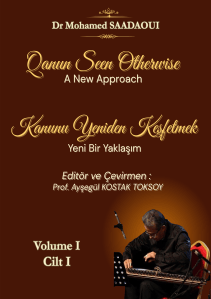
Volume I – A New Practice
Tome I – A New Practice
The foundations: monochords and dichords. Bare-finger exercises, two-part harmony, and a first approach to contrary motion and counterpoint on two strings.
Les fondations : monocordes et dicordes. Exercices aux doigts nus, harmonie à deux voix, et une première approche du mouvement contraire et du contrepoint sur deux cordes.
Available on Amazon / Disponible sur Amazon
Preface / Préface
When we look at the existing qanun methods mostly, we see that some of them are repertoire books that are far from the systematics of universal instrument methods. In the education program carried out in our conservatories, the need for that kind of methods distinctly emerges.
This book, titled “Qanun Seen Otherwise- New Practice”, is a study that Dr. Mohamed Saadaoui has been working on for a long time, developed to provide extremely important gains in the education of the qanun instrument, and primarily aims to create a very solid technical background for beginner students. In addition, the advanced exercises in the method will make an important contribution to the exercises that experienced performers need to maintain their technical dominance. In particular, harmony and counterpoint-based studies in this category are an important source for laying the right foundations in improvisation and polyphonic based ornamentation approaches in qanun performance. In addition to the traditional understanding of qanun practice, important exercises in which the “plectrum and finger playing technique” are combined and, some modern playing techniques are also included in the book.
As a result, the book is an important study to be used in qanun education with these features.
Lorsque l’on examine les méthodes de qanun existantes, on constate que la plupart sont des recueils de répertoire, éloignés de la démarche systématique des méthodes instrumentales universelles. Dans le programme d’enseignement de nos conservatoires, le besoin de méthodes de ce type se fait clairement sentir.
Ce livre, intitulé « Qanun Seen Otherwise – New Practice », est le fruit d’un long travail du Dr Mohamed Saadaoui. Il a été conçu pour apporter des acquis essentiels à l’enseignement du qanun et vise avant tout à donner aux élèves débutants une base technique très solide. Les exercices avancés de la méthode apporteront en outre une contribution importante au travail dont les interprètes expérimentés ont besoin pour conserver leur maîtrise technique. Les études fondées sur l’harmonie et le contrepoint, en particulier, constituent une source précieuse pour poser de bonnes bases en improvisation et dans les approches d’ornementation polyphonique du jeu du qanun. Outre la conception traditionnelle de la pratique du qanun, le livre propose des exercices importants associant la technique du plectre et celle des doigts, ainsi que certaines techniques de jeu modernes.
En conclusion, par ces qualités, ce livre constitue un travail important pour l’enseignement du qanun.
Prof. Ayşegül KOSTAK TOKSOY, ITU Turkish Music State Conservatory, Lecturer at the Department of Instrument Education
(traduction française de la préface originale en anglais)
Volume II
Tome II
Trichords / Les Tricordes
Eighteen Motifs and their Mirrors, written in the Four-Color Code, where the rest-stroke and new techniques find their place. The plectrum section closes with a systematic study of contrary motion and counterpoint, building the independence of the hands, a discipline rarely found in Qanun playing.
Dix-huit Motifs et leurs Miroirs, écrits avec le Code des 4 Couleurs, où la butée et des techniques nouvelles trouvent leur place. La partie au plectre se clôt sur une étude systématique du mouvement contraire et du contrepoint, qui construit l’indépendance des mains, une discipline rarement présente dans le jeu du Qanun.
Harmony with Bare Fingers / L’Harmonie aux Doigts Nus
Played with fingers 1, 3, 4 and 5, the second finger remaining free for the plectrum. Harmony here is conceived with the fingers of a Qanun player, not those of a pianist: conjunct lines in contrary motion, where a single ordinary interval gives rise to a wealth of combinations and phrases pleasant to the ear. Intervals are studied one by one, then combined, up to two-part harmony with the third in the bass, doubled at the octave.
Jouée avec les doigts 1, 3, 4 et 5, le deuxième doigt restant libre pour le plectre. L’harmonie est ici pensée avec les doigts d’un Qanuni, et non avec ceux d’un pianiste : des lignes conjointes en mouvement contraire, où un seul intervalle banal fait naître une multitude de combinaisons et de phrases agréables à l’oreille. Les intervalles sont étudiés un à un, puis combinés, jusqu’à l’harmonie à deux voix avec la tierce à la basse, doublée à l’octave.
In English & French · Forthcoming / En Anglais & Français · À Paraître

